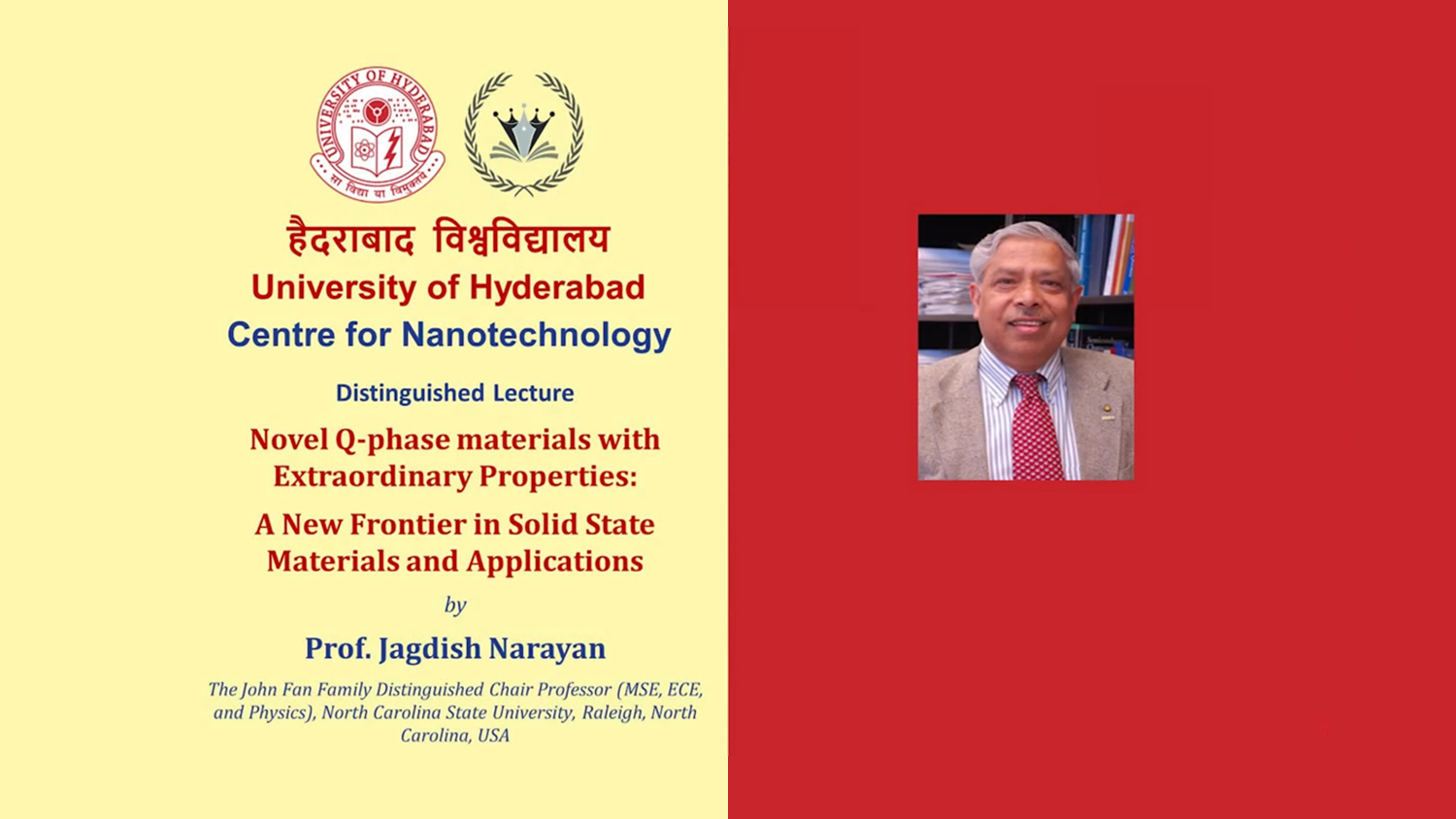
Since the late 1970s, Professor Jagdish Narayan and his colleagues have pioneered new frontiers in nanoscience and nanotechnology. Their early discovery of nickel nanodots embedded in ceramics, first reported in Physical Review Letters (PRL) in 1981, opened a pathway to controlling matter at the nanoscale and reshaping its optical, mechanical, and electronic properties. This foundational work led to a cascade of breakthroughs, from domain‑matching epitaxy to the invention of nano‑pocket LEDs and the creation of Q‑carbon and Q‑BN, new phases of matter with extraordinary hardness, superconductivity, and device potential. The Narayan group’s research illustrates how manipulating atoms with lasers and non‑equilibrium processes can create materials once thought impossible under ambient conditions, with applications spanning energy, electronics, quantum devices, and information storage.
Data & Storage Potential
Proposed nanodot architecture for ultra-dense storage
Showed potential for chip-level terabyte capacity
Positioned nanoscale systems for next-gen electronics
key breakthroughs
Epitaxial Nanodots in Ceramics (1981→)
Domain‑Matching Epitaxy (DME)
Nano‑Pocket LEDs (GaInN/GaN)
Nonequilibrium Laser Processing
Q‑Carbon and Q‑BN
Timeline
-
Late 1970s
Start of Narayan lab nanomaterials research
-
1981
PRL paper on Ni colloids (nanodots) in crystalline ceramics
-
1990s–2000s
GaN/AlN/ZnO epitaxy and devices
-
2002–2005
LED device patents
-
2013
Acta Gold Medal paper
-
2015
Q‑carbon patents
-
Present
NNNR Patents
U.S. Patents Granted and Applied
| Patent No. | Year | Title / Scope |
|---|---|---|
| US 4,376,755 | 1983 | Refractory oxides with colloidal metal precipitates |
| US 6,423,983 | 2002 | ZnMgO/CdMgO optoelectronic devices |
| US 6,518,077 | 2003 | ZnMgO/CdMgO devices (methods) |
| US 6,734,091 | 2004 | Electrode for p-type GaN |
| US 6,847,052 | 2005 | LED device geometry |
| US 6,881,983 | 2005 | Efficient LEDs and lasers |
| US 6,955,985 | 2005 | Domain epitaxy for thin film growth |
| US 7,122,841 | 2006 | Bonding pad for GaN LEDs |
| US 7,803,717 | 2010 | Epitaxial GaN on Si(111) |
| US 11,189,774 | 2021 | B-doped Q-carbon superconductor |
| US 11,011,514 | 2021 | Doping & fabrication of diamond and c-BN devices |
| US 10,906,104 | 2021 | Wear-resistant materials |
| US 10,586,702 | 2020 | Q-carbon synthesis & processing |
| US 10,566,193 | 2020 | Q-carbon, graphene, and diamond |
| US 10,529,564 | 2020 | Q-BN synthesis & processing |
| US 10,240,251 | 2019 | NV nanodiamonds for quantum applications |
| US 10,211,049 | 2019 | NV nanodiamonds & nanostructures |
| US 10,196,754 | 2019 | Doped diamond conversion |
| US 5,221,411 | 1993 | Continuous monocrystalline diamond thin films |
| Pub. No. | Year | Title / Scope |
|---|---|---|
| US 2020/0149151 A1 | 2020 | Diamond nanofibers; laser-driven diamond growth |
| US 2019/0363078 A1 | 2019 | Doping & fabrication of diamond and c-BN devices |
| US 2017/0373153 A1 | 2017 | Pure and NV nanodiamonds & nanostructures |
| US 2017/0370019 A1 | 2017 | NV nanodiamonds |
| US 2017/0037540 A1 | 2017 | Conversion of BN into doped c-BN |
| US 2017/0037534 A1 | 2017 | Direct conversion of h-BN → c-BN |
| US 2017/0037533 A1 | 2017 | Novel phase of boron nitride (Q-BN) |
| US 2017/0037532 A1 | 2017 | Conversion of carbon into doped diamond |
| US 2017/0037531 A1 | 2017 | Direct conversion of carbon into diamond |
| US 2017/0037530 A1 | 2017 | Q-carbon, graphene, and diamond processing |
| US 2017/0036917 A1 | 2017 | NV nanodiamonds |