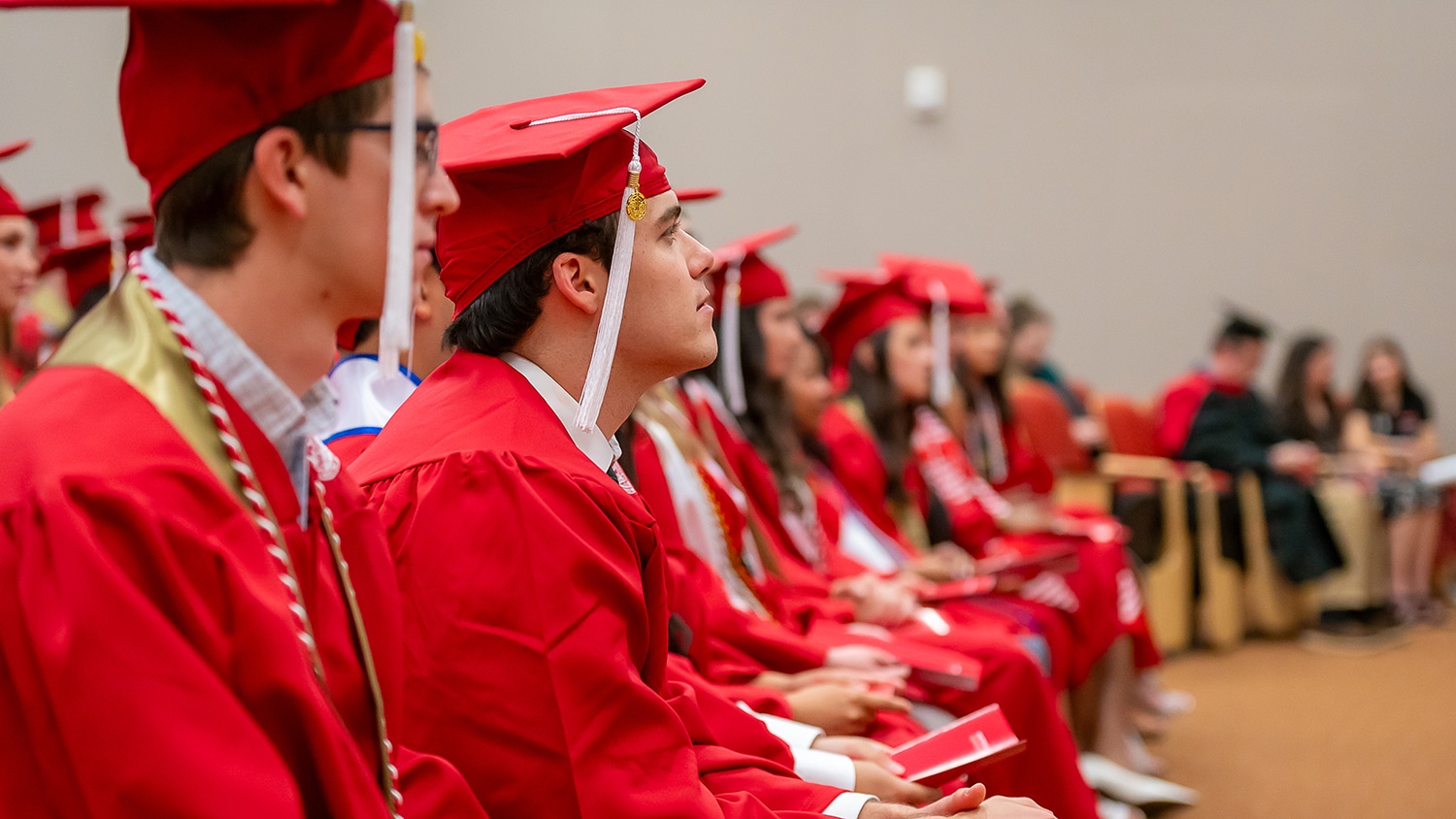
Wolfpack Red at TMS 2026

In mid-March, as materials scientists from around the world converged on San Diego for the 2026 Minerals, Metals & Materials Society (TMS) Annual Meeting, one color kept standing out in the crowds: Wolfpack Red.
From buzzing student competitions to packed technical sessions and hallway conversations that stretched late into the evening, the Department of Materials Science and Engineering at NC State made its presence felt. What began just a few years ago as a modest showing has grown into a visible, multi-layered footprint that spans undergraduate engagement, cutting-edge research and national leadership.
A New Generation Steps Forward
For MSE’s undergraduates, TMS 2026 was more than a conference; it was a glimpse of the careers and discoveries that could lie ahead.
The NC State Material Advantage Student Chapter delegation, composed of Julia Kalinina, Cordelia McKelvy, Avery Smith, Aaron Thomas, Grant Ozaki, Adriana Lara, Lana Bess, Alia Fayed, Ariel Nguyen and Janelle Rasp, represented a range of sophomore and junior materials science and engineering majors. For many of these students, it was their first major professional conference. Their days quickly filled with technical sessions, poster talks and conversations with researchers and industry professionals who had once been in their shoes. Between events, they shared snapshots and reflections on social media, offering a real-time window into the TMS experience from a student’s point of view.
The “Atomic Pack” Returns
One of the most visible stages for students at TMS is the Materials Bowl, a high-energy competition that tests materials knowledge and quick thinking.
MSE’s “Atomic Pack” team of Adriana Lara, Grant Ozaki, Aaron Thomas and Caleb Schenck returned to San Diego with the momentum of the program’s 2025 runner-up finish. Facing universities from across the country, they carried forward the tradition of NC State’s strong showing on a national stage.
Research at Every Scale
While students explored, MSE faculty and researchers were woven throughout the technical backbone of the conference. Department Head and Kobe Steel Distinguished Professor Donald Brenner helped lead conversations on the future of materials education through the Judson Education Symposium and delivered invited talks on high-entropy carbides and advanced simulation methods. Professor Jay Narayan and graduate students Naveen Joshi, Pranay Kalakonda, Siba Sahoo, Sriram Srinivasan and Kishan Kumawat were featured prominently in the electronic, magnetic and energy materials program, with keynotes and talks on 2D materials, diamond-like thin films and wafer-scale diamond integration.
Across multiple symposia, Assistant Professor Bharat Gwalani’s Lab for Agile Manufacturing and Rapid Characterization (LAMaRC) showcased work spanning solid-state processing, high-temperature deformation, irradiation effects and defect characterization. His research team, graduate students Caleb Schenck, Emmanuel Aikulola, Michael Lastovich, Charles Perkins, Md Jasim Uddin, Farhan Ishrak and Postdoctoral Research Scholar Fu-Yun Tsai, presented on topics ranging from high-entropy alloys and compositionally complex carbides to nano-thermite reactions and solid-state magnet processing. The work also reflects research collaborations with partners, including Professor Martin Thuo. Gwalani also helped organize and chair sessions on structural alloys, vacancy engineering and advanced nuclear materials, threads that connected NC State research to community-wide efforts in designing materials for extreme environments.
The NC State footprint extended further through Associate Professors Rajeev Gupta, Kinga Unocic and Raymond Unocic, who helped organize and lead sessions on surface engineering, corrosion, environmental degradation and advanced characterization.
Recent Ph.D. graduates Jijo Christudasjustus, Matthew deJong, Sean O’Brien and Venkata Vukkum, now at places like Pacific Northwest National Lab, returned as organizers and speakers, underscoring how MSE’s impact continues long after graduation. Poster sessions and technical talks featured graduate students Swaroop Saralkar, Mahmoud Hawary, Marium Mou and Tarek Haque and postdocs Andrew Martin, Alana Pauls, Jorge Galeano and Sam Daigle, who work on everything from molten salt reactor materials and hydride formation in nuclear alloys to machine-learning interatomic potentials for advanced ceramics.
In the midst of all this technical depth, Teaching Assistant Professor Sharon Thorne offered a complementary perspective. Presenting on materials education, she emphasized how classroom innovation and student-centered teaching propel the next generation of researchers and practitioners. For her, one of the most rewarding parts of TMS was simply looking around and seeing so many familiar faces, from undergraduates experiencing their first major conference to alumni and collaborators shaping the field across the globe.
A Clear Trajectory
By the time flights home lifted off from San Diego, the NC State MSE community had left its mark on TMS 2026, in session rooms and poster halls, in competition arenas and committee meetings and across social media feeds capturing the week. The conference wasn’t just a series of talks; it was a vivid snapshot of a department operating at every level of the materials ecosystem, with students learning, faculty leading, alumni advancing and the Wolfpack supporting one another at every step.